
You’ve probably heard us say a mix of “ZFS” and “OpenZFS” and an explanation is long overdue. Our Senior Analyst clears up what ZFS and OpenZFS refer to and how they differ.

ZFS vs. OpenZFS
read more
The world’s number one open-source operating system, TrueNAS brings the performance and features of the legendary OpenZFS file system in an easy to use package. Available in two free and open-source software versions, TrueNAS also comes as a professionally-supported Enterprise solution when coupled with iXsystems branded hardware.
You’ve probably heard us say a mix of “ZFS” and “OpenZFS” and an explanation is long overdue. Our Senior Analyst clears up what ZFS and OpenZFS refer to and how they differ.

The iXsystems Team discusses how to set up the S3 service on FreeNAS, as well as how to connect several S3 tools to the storage. With Plugins, Jails, Docker, VMs, S3 object storage, and cost savings of up to 80% compared to renting cloud storage, FreeNAS and TrueNAS are the perfect storage platforms for developers and web service providers.

Syncing FreeNAS or TrueNAS with Dropbox has many advantages. Here, we share a tutorial on how to sync files to Dropbox with FreeNAS and/or TrueNAS.

The TrueNAS M50 integrates multiple buzz-worthy technologies to deliver large amounts of low-latency storage. The M-Series accelerates a broad range of workloads–safely and economically. Speaking of economics, according to the iXsystems website, TrueNAS storage can be expanded for less than $100/TB. That should be music to the ears of business people everywhere.

A new version of Netatalk (3.1.12) has been released that addresses a security vulnerability (CVE-2018-1160) for users of the Apple Filing Protocol (AFP).

The recent release of TrueNAS®11.1-U6 introduces a new built-in service that seamlessly integrates with Asigra Backup software. With this integration, an existing TrueNAS® system can be configured as backing storage for Asigra backup clients while simultaneously performing all the responsibilities of a traditional network attached storage system.

Ohio Linux Fest 2018 was held in Columbus at the Hyatt Regency. Warren Block, Dru Lavigne, and JT Pennington attended from iXsystems and staffed the FreeBSD booth in the expo area.

The iXsystems team descended upon the Storage Networking Industry Association (SNIA)’s Storage Developer Conference last week in full force. SDC is an unrelenting technical conference, packed full of technical sessions, keynotes, Birds of a Feather events, at least one plugfest running throughout, and a very active hallway track. This year, we presented two technical sessions, led two Birds of a Feather sessions, and participated in the SMB plugfest.
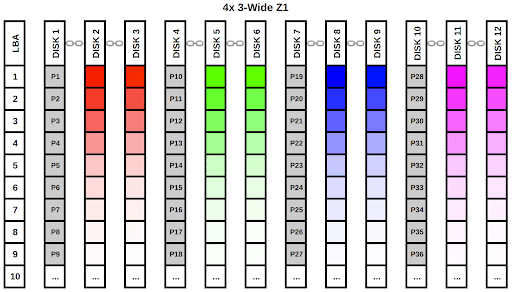
In the first post, we discussed the importance of planning the ZFS pool layout which has a huge impact on how the system performs. To quantify this performance, we are looking at six key metrics: read I/O operations per second (IOPS), write IOPS, streaming read speed, streaming write speed, storage space efficiency (usable space after parity/total raw space), and fault tolerance (maximum number of drives that can fail before data loss).
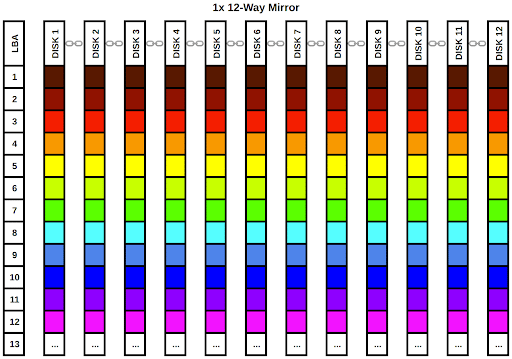
The layout of a ZFS storage pool has a significant impact on system performance under various workloads. Given the importance of picking the right configuration for your workload and the fact that making changes to an in-use ZFS pool is far from trivial, it is important for an administrator to understand the mechanics of pool performance when designing a storage system.