
Storage for Virtualization, Without Becoming a Project


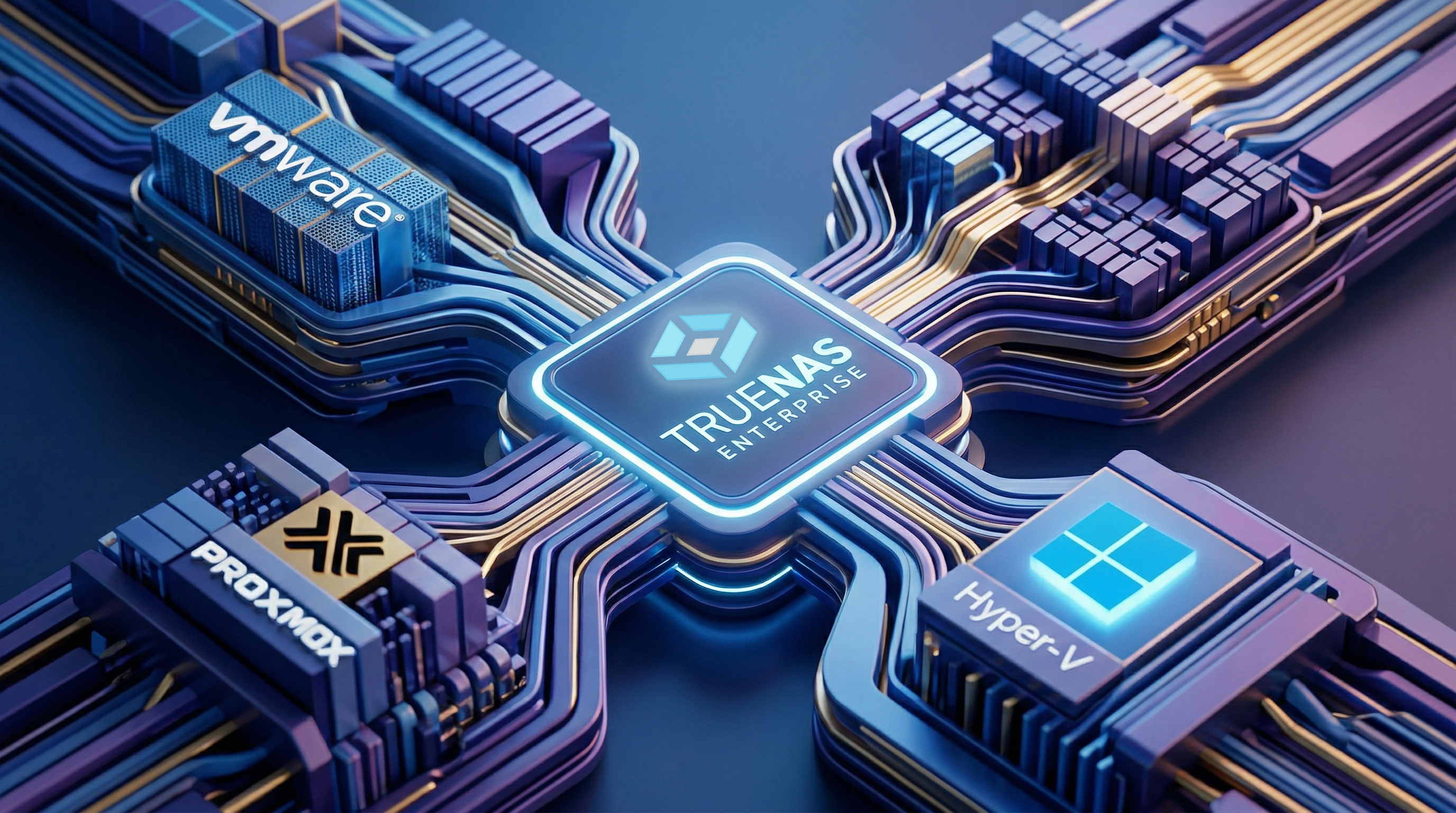
TrueNAS Enterprise delivers shared storage for VMware, Proxmox, and Hyper-V.
Consistent performance under concurrent load. Data integrity baked in.
Ready to run in the environment you already have.
Address Real World Virtualization Challenges
Validated Integration with VMware, Proxmox, Hyper-V, and More
TrueNAS Enterprise fits cleanly into your virtualization environment via standard storage protocols or native plugin integration. Got Citrix, Xen, OpenShift or Kubernetes? We’ve got you covered. Need more Capacity for Nutanix? Add TrueNAS.
Your team keeps working the way it already does—with what’s now and what’s next.
Performance Under Pressure
When VMs compete for storage — backups running, patches deploying, boot storms hitting, workload spikes — the quality of your storage determines how bad contention gets and how long it lasts.
TrueNAS Enterprise All-flash and hybrid configurations deliver consistent low-latency performance under load.

Data Availability and Integrity
Dual-controller HA with automated failover keeps production running in mission critical environments. Sequential controller updates maintain availability during planned maintenance.
Uptime alone isn’t enough – data corruption is automatically detected and repaired while snapshots provide fast, space-efficient recovery points for VMs.

The Platform For Modern Virtualization
“We bought an M40 for virtualization, using NFS with Red Hat. Later, we upgraded to XCP-ng and bought a couple more boxes. Now our security group and backup group are both deploying it.” — Mark Williams, NIST

Native integration with VMware, Proxmox, Hyper-V, and OpenShift — with built-in support for the protocols your environment already uses.
TrueNAS connects directly to your hypervisor using native integrations — vCenter plugin with VAAI, Proxmox API integration, OpenShift CSI Driver, and SMB for Hyper-V. Standard protocols — NFS, iSCSI, SMB, Fibre Channel, and NVMe-oF — are built in, not layered on. No storage gateways. No protocol adapters. Your team manages storage through familiar tools, without introducing new operational complexity.

Higher-performance storage lets you run more VMs per host. Fewer hosts means fewer licensed CPU sockets — and lower VMware cost, without changing your hypervisor.
Not every VMware cost-reduction strategy starts with a hypervisor change. Pairing TrueNAS Enterprise with a server refresh — higher clock speeds, lower CPU counts — lets teams consolidate VMs onto fewer hosts. Your hypervisor environment stays intact. Licensing pressure goes down.

Complex storage creates operational risk — misconfigurations, failed updates, recovery gaps. TrueNAS Enterprise reduces that risk with one consistent platform and one UI across every system.
Every TrueNAS system — from all-flash to hybrid to capacity-dense systems — runs the same platform and the same UI. One platform to qualify in your environment. One interface for your team to learn. No different tools for different product lines. No retraining when you add capacity or change tiers. Built-in snapshots, replication, and automated failover reduce manual processes and the risk of human error. Full API access enables automation for teams that need it. When storage is simpler to operate, your team spends less time firefighting and more time on the work that actually matters.
TrueNAS Enterprise uses a clear cost model — no arbitrary licensing resets, no vendor-driven cost shocks. Costs scale with the storage infrastructure you deploy, not artificial licensing boundaries.
You're not locked into proprietary formats or vendor-driven upgrade cycles. Systems can be expanded, refreshed, and integrated without replatforming or relicensing. Everything is delivered as a unified TrueNAS appliance with enterprise support — a proven system to deploy and manage.
Every additional storage system adds another maintenance cycle, another upgrade window, and another vendor to manage. TrueNAS consolidates file and block workloads onto a single system — so your team spends less time on storage infrastructure.
One system to patch. One system to upgrade. One support relationship. When storage is consolidated, the operational overhead that slows teams down — context-switching between tools, coordinating across vendors, troubleshooting mismatched configurations — is reduced.
Performance isn’t just peak IOPS — it’s how storage behaves when everything is happening at once.
OpenZFS ARC (Adaptive Replacement Cache) keeps active VM data in memory, reducing disk reads and smoothing latency during mixed workloads. When backups run, patches deploy, or boot storms hit, performance remains predictable instead of collapsing under contention. All-flash and hybrid configurations deliver consistent low-latency performance — not just benchmark peaks.

Most virtualization environments also serve file shares, project data, and media. TrueNAS handles block storage for your VMs and file storage for everything else — one system, not two.
TrueNAS Enterprise runs file and block workloads on the same platform, with a single management plane and shared capacity pool. Flash and disk can be combined in the ratio your workloads require — and expanded independently as those workloads evolve. All-NVMe and hybrid architectures support both latency-sensitive VMs and general-purpose file data — no separate NAS system, no separate capacity tier.
Unstructured data is growing faster than primary storage was designed for. File shares, project data, media, and archives need capacity-dense storage with enterprise reliability and performance — without the same price tag. Easily add file services to your Nutanix / HCI clusters.
TrueNAS Enterprise deploys alongside existing VM storage infrastructure as a capacity and file tier — supporting unstructured data, shared storage, and growing datasets. Hybrid configurations combine flash and disk to match performance to data needs — easily add capacity and performance as your data grows. Same enterprise support, same data integrity, same management simplicity — on a system designed for the rest of your data.

Stay online through failures and maintenance — not just steady-state uptime.
Dual-controller high availability with automated failover keeps workloads running during hardware events. Sequential controller updates allow systems to be upgraded without taking storage offline. Combined with ZFS end-to-end checksums for auto verification of data on every read, write, and background verification checks, TrueNAS protects not just uptime — but the integrity of the data your VMs depend on.
Running VMs? Protection belongs in the same conversation.
Virtualization with TrueNAS
More than 60% of Fortune 500 companies run TrueNAS.

Case Studies
We bought an M40 for virtualization, using NFS with Red Hat. Later, we upgraded to XCP-ng and bought a couple more boxes. Now our security group and backup group are both deploying it. — Mark Williams

Case Studies
TrueNAS' support has been incredible. And given our commitment and in the context of how important the data is to our researchers, it has to be. — Ron Simpson

Case Studies
We're sticking a lot of eggs in one basket and we needed around the clock support to keep our virtualization infrastructure up. — Peter Losher

Case Studies
TrueNAS allowed us to virtualize everything we do in our manufacturing operations from just a single storage unit. TrueNAS gives us an edge. — John Konc

Case Studies
It's a great system and gives me the peace of mind I need for my production environment. It just works. — Brad Davis

Case Studies
Due to strict security measures, these locations could not be accessed over the internet, so deployment and support had to be performed on site.
Resources
Virtualization Infrastructure
Virtualization Storage
Let’s Find the Right Fit
We’ll help you quickly identify the right solution, tailored to your workflow.