
How to Evaluate S3-Compatible Object Storage
SNIA, the storage industry association, notes that most, if not all, storage vendors implement S3 as their primary object storage API, and that real-world interoperability issues still persist. The "S3-compatible" label tells you which API a platform speaks. It...
Migrating from VMware to Proxmox and what to do about your storage
If you're planning a move from VMware to Proxmox, you've probably already read plenty about the hypervisor side. Storage is where the surprises tend to show up, because the datastores you know from VMware map onto several different Proxmox options, and the one you...
Edge Computing Storage: What to Look For in an Appliance
Picking storage for an edge site can feel like packing for a trip where you can't go back for anything you forgot. The site often has less space, less power, and a thinner network link than a data center, and there's often nobody nearby who works in IT. The good news...
Hybrid Flash Storage for Enterprise Workloads: How to Balance Performance, Capacity, and Cost
Hybrid flash storage combines solid-state drives (SSDs) and hard disk drives (HDDs) in one storage design, so fast flash serves your active data and lower-cost disk holds the rest. If all-flash pricing is the sticking point, hybrid is the design to price it against....
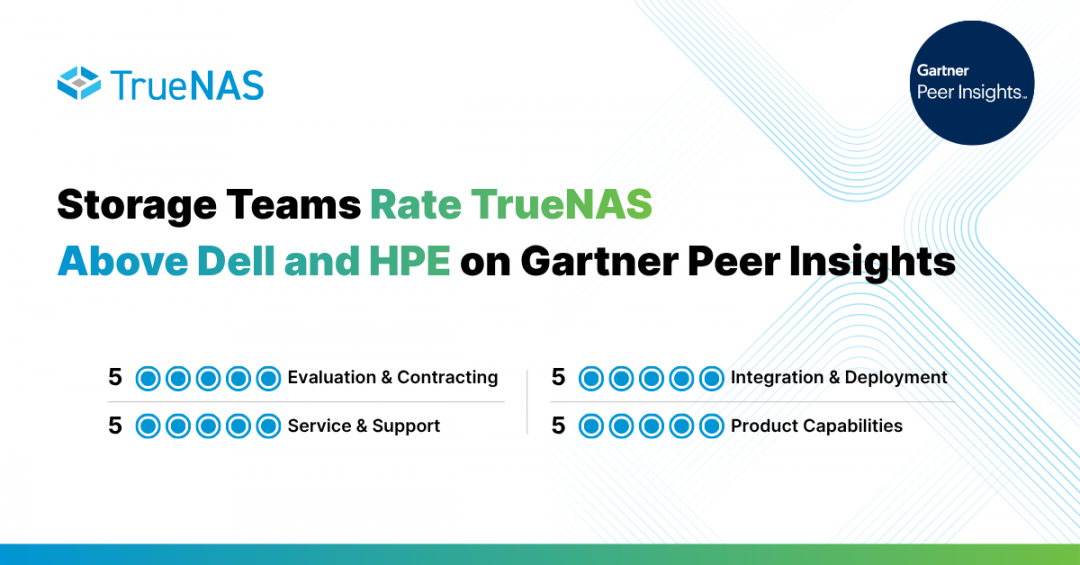
Storage Teams Rate TrueNAS Above Dell and HPE on Gartner Peer Insights
Enterprise storage usually forces a choice. You trade performance for cost, or simplicity for flexibility. When AI demand pushed DRAM and flash prices up, incumbent vendors passed the cost to buyers and kept pushing all-flash. While AI workloads land on infrastructure...

Choosing Storage for AI Workloads: File, Block, or Object?
It's tempting to treat file, block, and object storage as three competing options and just pick one. SNIA, the vendor neutral group that defines these categories, describes block storage as data handled in fixed size chunks, file storage as a stream of bytes...
TrueNAS 27 is Here!
TL;DR: The release previously tested as TrueNAS 26 is now TrueNAS 27, starting with RC.1 in October 2026, because most users will run it during 2027 and the community asked for version numbers that match the year a release is deployed. The schedule is unchanged, and...
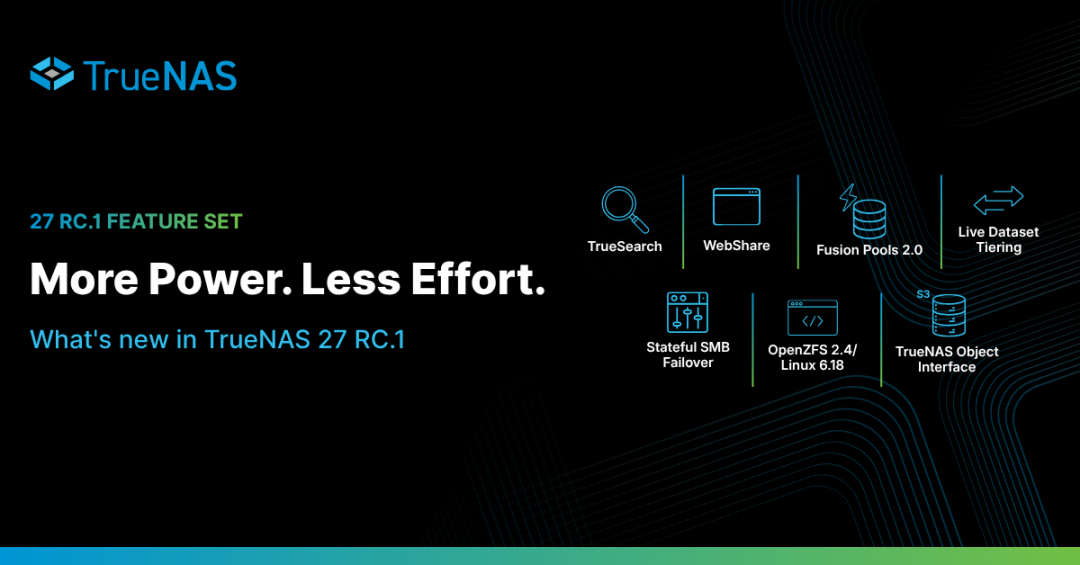
TrueNAS 27 RC.1: The Feature Set
TL;DR TrueNAS 27 is the next major release of TrueNAS, built on OpenZFS 2.4 and Linux kernel 6.18. It was previously numbered TrueNAS 26. RC.1 is the first release candidate, and TrueNAS 27.0 is scheduled for early December 2026. Highlights: TrueSearch and WebShare:...
Is Your ZFS NAS Actually Running OpenZFS?
How a few bytes of difference means your data might be locked to hardware or a vendor you can't easily replace. You chose a ZFS-based NAS for the right reasons. ZFS has a decades-long track record of data integrity, mature tooling, and a thriving open-source community...
The OME-Zarr S3 Trap: Why Native NFS Ingest is Faster
The S3FS Translation Tax If you’re setting up OME-Zarr for high-throughput microscopy, you probably assume you need to use S3 for the entire pipeline. That’s a mistake that will bottleneck your local ingest. OME-Zarr is an encapsulation format and programming library...