
Hybrid storage combines high-capacity spinning disks with flash-based caching and metadata layers, so data gets HDD economics with SSD-like responsiveness where it matters most.
The all-flash default made sense for a while. NVMe prices dropped fast enough that overprovisioning felt responsible. Why spend time designing careful storage tiers when flash was cheap enough to ignore the question?
That logic expired somewhere around late 2025, when NAND supply constraints pushed flash prices significantly higher. Renewal quotes that looked reasonable 18 months ago now look like different documents. Organizations running flash-only platforms are finding out something uncomfortable; when your vendor only sells one tier, their supply chain exposure becomes your budget problem.
Reach out to us today to see how TrueNAS compares to flash-only alternatives.
The assumption that broke
The “all-flash by default” architecture was always a cost argument dressed up as a performance argument. Flash is faster, so the pitch was simple – “just buy flash, and stop worrying.”
What it glossed over is that most enterprise data doesn’t need flash performance. It just got priced like it did – because flash was cheap enough that the waste wasn’t visible.
It’s visible now – and “just buy flash” is a distant memory.
HDD vs. SSD Economics: Most of your data isn’t hot
Look at a typical enterprise data footprint. Primary databases, VDI boot volumes, latency-sensitive transactional workloads – these genuinely benefit from NVMe. But they’re a fraction of what most organizations store.
Backup repositories, archive, compliance holds, media libraries, secondary copies, DR replicas – this data needs to be durable, accessible, and reasonably performant. It doesn’t need sub-millisecond latency. On a flash-only platform, you’re paying for a performance tier that most of your data will never use.
The question isn’t whether flash is better for performance – it is, for the workloads that need it. The question is whether every byte in your environment demands the expense.
How TrueNAS makes Hybrid Storage work
TrueNAS is built on OpenZFS, and ZFS was designed with hybrid storage as a first principle – not an afterthought bolted on after spinning disk stopped being the only option.
The architecture works in layers:
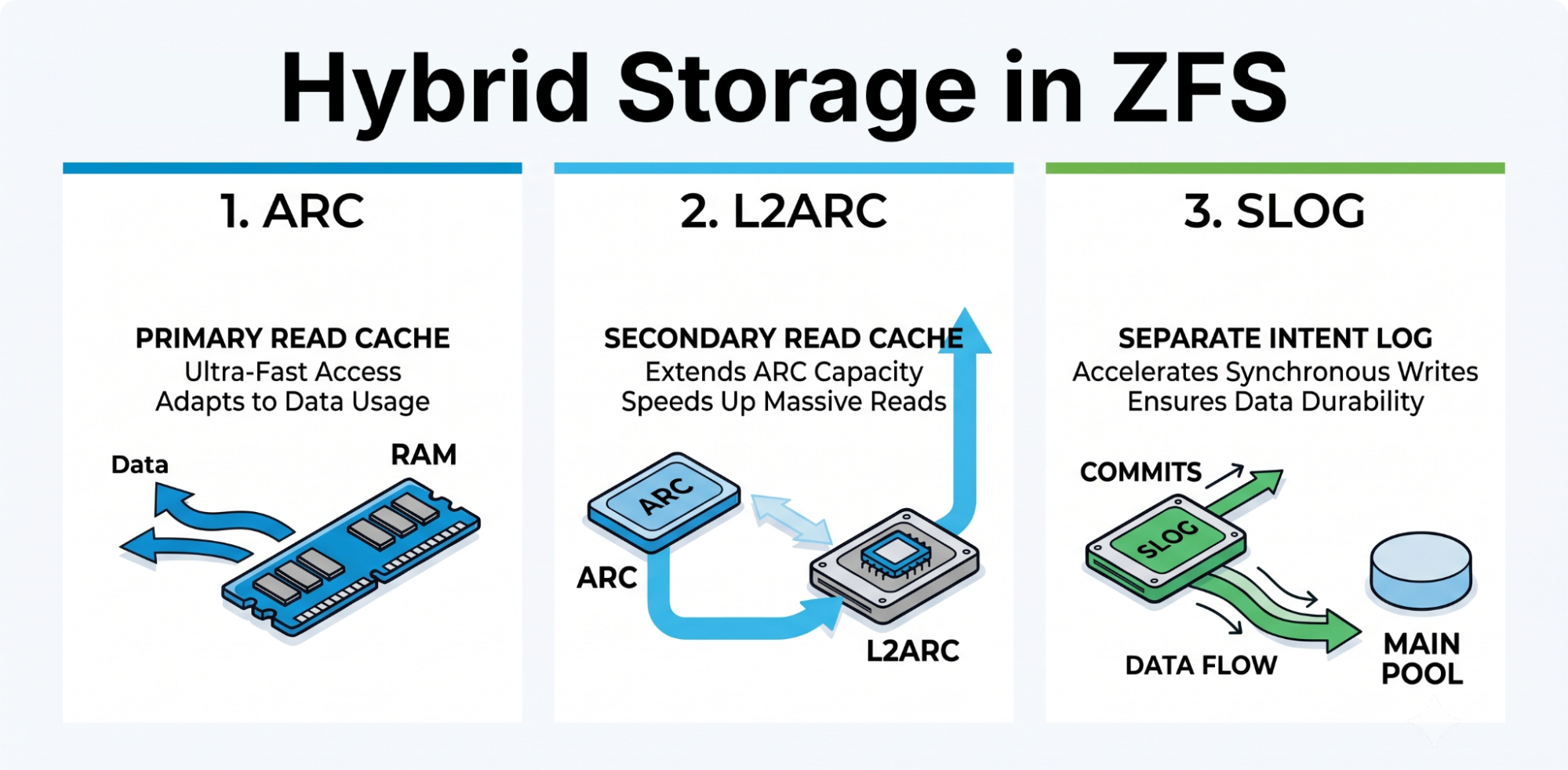
ARC (Adaptive Replacement Cache) lives in system RAM. On reads, the most frequently accessed data is served directly from memory – no drive access required, latency effectively zero.
L2ARC extends the read cache onto SSD. Data that’s frequently accessed but not hot enough for RAM gets served from flash without permanently consuming space there. You get flash-speed reads on frequently-accessed capacity data, without paying for all-flash capacity pricing.
SLOG (Separate Log) handles synchronous writes. Instead of waiting for data to commit to spinning disk vdevs, synchronous writes are protected immediately on a dedicated high-performance SSD, get acknowledged to the client, and then flush from memory to the primary pool devices. Write latency drops significantly for databases and virtualization workloads – without requiring an all-flash pool.
Special vdevs are where the architecture gets genuinely interesting. A special vdev stores ZFS metadata and, optionally, small blocks on dedicated fast media. Because ZFS reads metadata on nearly every I/O operation, putting metadata on fast drives accelerates the entire pool – not just the data stored on the special vdev. It’s not a temporary cache; it’s a permanent home for the data that drives the most I/O operations in the filesystem.
Currently, special vdevs require a mirror layout – two SSDs, 50% of raw capacity sacrificed to redundancy. The upcoming TrueNAS 26 changes this by adding RAIDZ support for special vdevs, making them more cost-effective for environments where capacity efficiency on the SSD tier matters.
Dataset Tiering in TrueNAS 26
The larger addition in the upcoming TrueNAS 26 is first-generation dataset tiering: manual, schedule-based data movement between storage tiers within a single ZFS pool.
The practical use case is backup ingest. New backup jobs land on a fast SSD tier first, giving the backup application the write throughput it needs during the ingest window. On a defined schedule, TrueNAS transparently relocates that data down to larger, capacity-based HDD vdevs. The relocation is done live – ZFS checksums are maintained, data integrity is preserved, and open file access continues uninterrupted throughout. Data tiering works seamlessly with the existing hybrid storage layers in TrueNAS – ARC/L2ARC remain available to accelerate data regardless of the tier, and SLOG protects synchronous writes.
With scheduled tiering, data doesn’t move based on access temperature or inferred heat maps. You set the policy; TrueNAS executes it. For environments where the data lifecycle is predictable – and most backup and archive workloads are – that’s exactly what you want: auditable, deterministic data movement without a black box making decisions on your behalf.
The TrueNAS engineering team is already hard at work to add even more tiering capabilities in 2027, helping to extend the native ZFS functionality and help provide relief from the current market costs for NAND storage.
ZFS was Always Right
None of this is new technology. ARC, L2ARC, SLOG, and special vdevs predate the NVMe era. ZFS was designed for a world where storage media had meaningfully different cost and performance characteristics, and where intelligent tiering was the only way to balance both.
The all-flash period was an anomaly – a window where NAND was cheap enough that architectural discipline looked optional. That window has closed. The market is rediscovering what good storage design looked like before oversupply made tiering feel unnecessary.
See how Hybrid Storage with TrueNAS Stacks Up
Organizations on flash-only platforms have no architectural answer to NAND inflation. When flash costs rise, the options are to absorb it, defer the refresh, or migrate to a different vendor.
TrueNAS runs the same operating system, the same management interface, and the same data services across all-flash, hybrid, and high-capacity configurations. If your workload mix shifts, your platform doesn’t have to. If flash pricing moves against you on renewal, hybrid is already built in – not a migration project.
If your most recent storage renewal quote looked significantly different from the last one, it’s worth asking whether your current platform has a different answer, or whether it’s just passing the cost through. Reach out to us today to see how TrueNAS compares to flash-only alternatives.