
Enterprise storage is usually evaluated on three familiar dimensions: performance, capacity, and price.
Those metrics matter. But they leave out a more fundamental question:
Can you trust the data?
That question deserves a much bigger role in enterprise infrastructure decisions. Because not all storage failures look like outages. Some of the most dangerous problems are quieter than that. A system may stay online. Applications may keep running. Dashboards may still populate. Backups may still complete. And yet, somewhere beneath the surface, data may be corrupted, altered, or damaged in ways that are not immediately obvious.
While traditional RAID solutions rely solely on periodic patrol reads to find data corruption, TrueNAS self-healing storage continuously verifies data against stored checksums on every read operation – supplemented by scheduled pool scrubbing – instantly and automatically repairing any corrupted data blocks using redundant copies. Corruption is caught and corrected before it reaches a backup, report, or decision.
Every storage device has an accepted rate of failure, called the “Uncorrectable Read Error” rate, often shortened to “URE.” These rates are mathematically rare – typically 1 in 1015 – so if you’re storing a small amount of data, the odds start in your favor – but the mathematical reality is that as total storage capacity and data access frequency grow, the probability of encountering these silent errors increases significantly. At multi-petabyte scale, it stops being theoretical – and becomes a routine occurrence. Because these issues happen at the individual drive level, they frequently bypass standard RAID protections, which are designed primarily to recover from complete drive failures.
That is the risk of silent corruption or “bit rot” – and it’s exactly why self-healing storage matters.
For business stakeholders, this isn’t a technical sidebar to be hand-waved, but a core business issue. Every forecast, customer interaction, compliance process, recovery plan, AI initiative, and board-level decision depends on trustworthy data. If the underlying data can’t be verified, then speed, scale, and cost efficiency begin to lose their value. Fast access to bad data isn’t an advantage – it’s just a faster path to the wrong outcome.
The Blind Spot in Enterprise Storage
When organizations compare storage platforms, the conversation often centers on throughput, latency, usable capacity, and cost per terabyte. Those are all reasonable criteria. But by themselves, they don’t answer a critical enterprise question: how does the platform help ensure that data remains correct over time?
That distinction matters more than many buyers realize.
Downtime is visible. Everyone knows when systems are unavailable. Silent corruption is different. It can sit unnoticed until data is restored, analyzed, audited, or used to make an important decision. By then, the problem is no longer just technical. It becomes operational, financial, and sometimes reputational.
This is why enterprise storage should not be judged only by how efficiently it stores data, but by how effectively it helps preserve trust in that data.
Availability tells you the system is up. Integrity tells you the data is right.
The best enterprise platforms do both.
What Self-Healing Storage Actually Means
At a high level, self-healing storage is designed to do more than simply hold data. It’s built to verify data continuously, detect inconsistencies, and – when the architecture includes the right protection – repair issues automatically before they become larger problems.
One of the key ideas behind this is the use of checksums. In simple terms, a checksum is a mathematical way to verify that data is still exactly what was written. Not just present. Not just accessible. Correct.
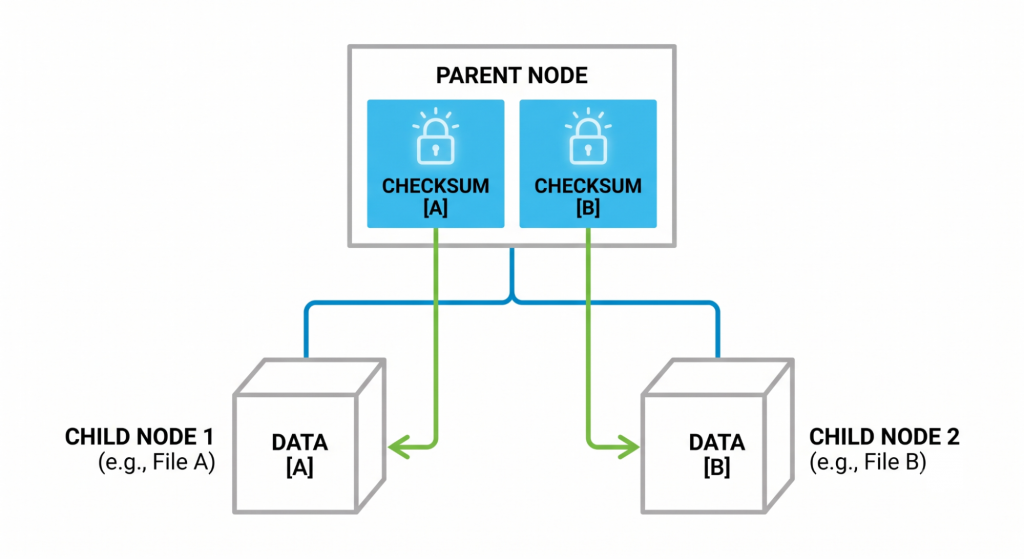
If the system detects that the data no longer matches what it should be, that mismatch is a warning sign. And if protected copies or redundancy are available through either mirrors or parity-based RAIDZ configuration, self-healing storage can use them to restore the correct version automatically. This is the benefit of the ZFS filesystem used within TrueNAS.
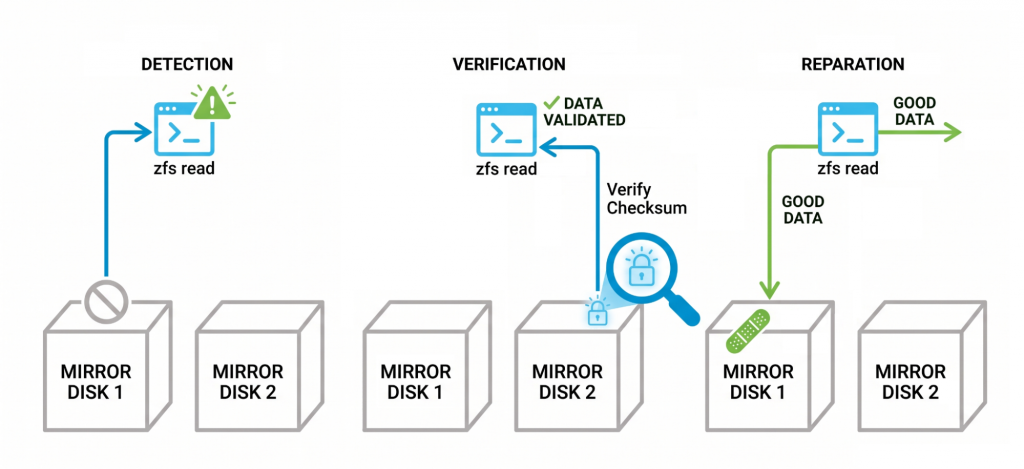
That changes the role of storage in the enterprise. Storage is no longer a passive repository. It becomes an active part of protecting data integrity.
For executive buyers, the takeaway is simple: self-healing storage helps reduce the risk of hidden data corruption turning into a visible business failure.
Why This Matters More Now
The need for data integrity is growing, not shrinking.
Enterprise environments are storing more data across more workloads for longer periods of time. Critical information now supports everything from virtual infrastructure and backup repositories to analytics pipelines, AI initiatives, file services, and long-term retention requirements. At the same time, organizations are under pressure to strengthen cyber resilience, improve recovery readiness, and do more with tighter operational and budget constraints.
That combination creates a new reality: the cost of untrusted data is rising.
If backups contain corrupted information, recovery becomes less certain. If analytics are built on damaged data, decisions become less reliable. If AI models are fed compromised datasets, the value of those investments can be undermined before they ever reach production. And if business-critical records cannot be validated with confidence, governance and compliance risks grow quickly.
This is why data integrity should be seen as a strategic requirement, not just a technical feature. It supports continuity. It supports resilience. And it supports confidence—the confidence that when the business needs its data most, that data will still be usable, trustworthy, and intact.
Is TrueNAS self-healing storage reliable enough for mission-critical data centers?
TrueNAS Enterprise is built for mission-critical data centers, pairing self-healing data integrity with high availability. TrueNAS Enterprise appliances provide dual-controller high availability with automated failover, 99.999% uptime, and non-disruptive software upgrades — so data stays both correct and continuously reachable.
Dual-controller high availability means continuous operations through automated rapid failover. If one controller fails, the other takes over without data loss, so mission-critical workloads keep running. Non-disruptive upgrades and online expansion let teams apply maintenance without a maintenance window that takes storage offline.
Self-healing runs underneath. The same platform that delivers five nines of uptime also verifies every block against its checksum and repairs corruption automatically — before it reaches a backup, report, or decision. For mission-critical environments, high availability keeps the system up and self-healing keeps the data right.
TrueNAS and the Business Value of Data Integrity
This is where TrueNAS changes the conversation.
TrueNAS is built to deliver more than enterprise performance and scale. It’s designed to help organizations protect the integrity of their data as a native part of the platform. That means helping detect silent corruption, preserve recoverable copies of data, and strengthen resilience at the storage layer itself.
For customers, that creates business value in several important ways.
First, it helps improve confidence in the data that powers the organization. Whether that data supports core applications, virtualization, backups, AI pipelines, or long-term archives, integrity matters. A platform that helps verify and protect that data is doing something fundamentally more valuable than simply serving it quickly.
Second, it strengthens recovery readiness. Snapshots and related data protection capabilities are not just convenience features. They are part of how organizations build more reliable recovery workflows and reduce uncertainty when incidents occur. In a world where ransomware resilience and business continuity are top priorities, that matters.
Third, it reinforces the idea that enterprise storage should be proactive, not reactive. Too many systems are designed to respond only after a failure becomes obvious. TrueNAS data integrity capabilities help identify and address issues earlier—before they escalate into downtime, data loss, or a failed recovery event.
Fourth, it brings these advantages into a broader enterprise platform story. TrueNAS covers file, block, and S3-compatible object workloads on one platform with one operational model. That means organizations can improve data integrity and resilience without introducing more silos, more tools, or more operational complexity.
And finally, it does this with the control and predictability enterprise teams need. Data integrity is most valuable when it’s part of a platform that supports long deployment lifecycles, clear economics, and infrastructure decisions that stay in your hands.
That is an important point. Data integrity is not a side feature. It’s part of what makes a storage platform enterprise.
A Better Way to Evaluate Enterprise Storage
As enterprise teams modernize infrastructure, they should ask more of their storage platforms.
Yes, performance matters. Capacity matters. Price matters.
But integrity matters just as much.
Can the platform help verify that data is still correct? Can it detect silent corruption before it spreads? Can it support stronger recovery confidence? Can it help preserve trust in the information the business depends on every day?
Those are enterprise questions. And they deserve enterprise answers.
For too long, the market has treated data integrity as a technical checkbox rather than a strategic advantage. That is a mistake. In modern environments, trustworthy data is not optional. It’s foundational.
The storage platforms that matter most in the years ahead will not be the ones that only move data faster or cheaper. They will be the ones that help organizations trust their data more completely—across operations, recovery, analytics, AI, and growth.
When Every Bit Matters
Enterprise leaders don’t invest in storage simply to hold more data. They invest in it to support operations, reduce risk, protect continuity, and give the business confidence in what comes next.
That is why self-healing storage matters.
Not because it sounds advanced. Not because it checks a technical box. But because it helps solve a real business problem: the gap between data being available and data being trustworthy.
TrueNAS helps close that gap. By building data integrity into the platform, it helps organizations move beyond storage conversations centered only on speed, scale, and cost—and toward a more complete definition of enterprise value.
Because when every bit matters, storage should do more than store data.
It should help protect trust in it.
If every bit matters to your business, your storage platform should be built to verify, protect, and recover data with confidence—not just hold it.
TrueNAS enterprise appliances combine self-healing storage, snapshots, unified workload coverage, and predictable economics in a platform designed for organizations that cannot afford to guess whether their data is still right.
Explore how TrueNAS can help you reduce hidden risk, strengthen recovery confidence, and bring enterprise data integrity to the workloads that matter most.
FAQs
Q: How does checksum verification differ from traditional RAID?
A: Traditional RAID solutions will show you if a physical error has caused a drive to return bad data. Checksum verification in TrueNAS can verify that the data is exactly what was originally written – not just that it was able to be returned from the disks without hardware error.
Q: How does the self-healing process work to reconstruct data?
A: Upon reading a block of data, TrueNAS recalculates its checksum – a hash or “signature” of the data – and compares it to the copy stored on disk. If the two don’t match, the data has changed since it was written, and TrueNAS redundancy kicks in: ZFS pulls the good copy from a mirrored drive, or, on RAIDZ, reconstructs the missing data mathematically from parity (using Reed-Solomon–style encoding for RAIDZ2/RAIDZ3)
Q: Are checksums protected during TrueNAS replication and snapshot jobs?
A: Yes – because the checksums are an integral part of the OpenZFS filesystem used by TrueNAS, your data stays protected throughout the entire process of protection and replication.